Smaller Footprint, Sharper Purpose: The Executive Case for Redesigning Instead of Relocating
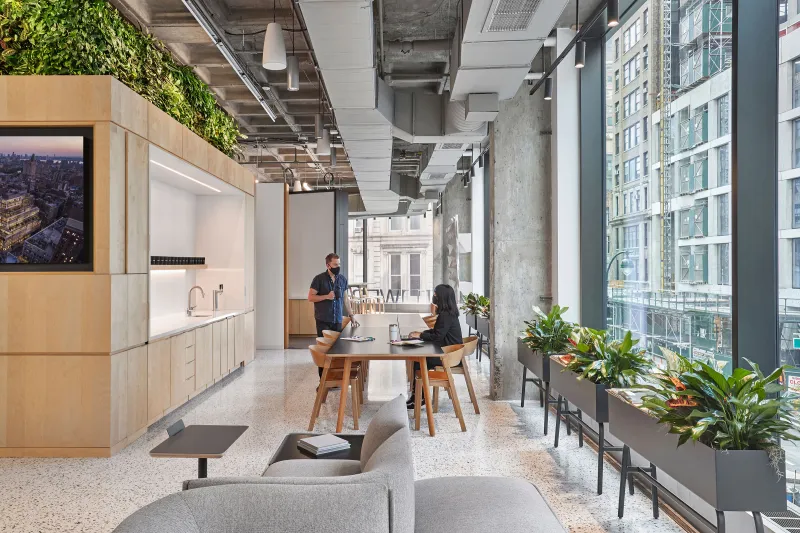
Photo: modern collaborative office lounge hybrid workplace interior design, via gbdmagazine.com
Across American metros, a familiar scene is playing out in boardrooms: the lease expiration is eighteen months out, attendance data shows the office is half-empty on Mondays and Fridays, and someone proposes the obvious — downsize, save money, done. It is an understandable instinct. It is also frequently the wrong one.
The companies getting the most from their real estate in the hybrid era are rarely the ones that simply shrank. They are the ones that redesigned.
Why the Downsizing Math Is Usually Overestimated
Relocation carries a stack of costs that rarely make it into the first spreadsheet: tenant improvements negotiated away in a softening or competitive market, moving logistics, IT infrastructure rebuilds, new building signage, and the productivity dip that comes when a workforce loses its bearings. Brokerage studies and our own project accounting consistently show that a move can consume twelve to twenty-four months of projected savings before a company breaks even.
Redesign, by contrast, works within an existing envelope. Construction disruption is phased. Systems and addresses stay put. And critically, the redesign can be targeted: you don't need less space so much as you need space that works harder.
What a Harder-Working Floor Plate Looks Like
Consider a pattern we see repeatedly with professional firms and mid-size corporate tenants. The traditional layout — one desk per employee, plus conference rooms — assumes full daily occupancy. Hybrid reality looks different: peak days near capacity, off-peak days nearly vacant.
The redesign response typically involves three moves:
Convert private offices to shared infrastructure. A floor of enclosed offices becomes a mix of focus rooms, phone booths, and open benching with reservation-based desks. The same square footage absorbs twice the peak headcount.
Rebalance meeting space. Hybrid teams need more small-format video rooms and fewer twelve-seat boardrooms. This is often a reallocation, not an addition — the same total square footage, redistributed to match actual behavior.
Invest in the destination. If employees come in two or three days a week, the office must outperform the kitchen table. That means better acoustics, hospitality-grade coffee and food programs, and collaborative zones worth the commute. In tenant improvement dollars, these amenities are cheap relative to rent; in recruiting value, they are disproportionately powerful.
The result: a company reduces its effective footprint per employee by 30 to 40 percent without moving an inch — and without the disruption, downtime, and relocation costs of a move.
Redesign Versus Relocation: The Checklist
If your leadership team is weighing the decision, work through these questions before calling a broker:
- What is your true peak occupancy? Badge data, not headcount, should drive the target. A 200-person company with a 45 percent peak utilization needs very different space than one at 80 percent.
- How much time remains on the current lease? Under five years, redesign economics almost always win. A move only becomes compelling when the lease itself is the problem.
- What would a relocation actually cost all-in? Include tenant improvements, movers, IT, downtime, and attrition risk — not just the rent delta.
- Does your current building support the redesign? Ceiling heights, mechanical systems, and floor plate depth all affect what's possible. A feasibility study answers this for a fraction of a broker's commission.
- What does your talent market expect? In competitive hiring markets from Austin to Charlotte, a thoughtfully designed destination office is a recruiting asset. A downsized, deprioritized one can read as a signal of decline.
- What is the phased plan? Redesigns done in phases preserve business continuity. If a proposal requires closing the office, the plan needs revision.
The Strategic Point
The hybrid era has not made offices obsolete. It has made mediocre offices obsolete. The organizations thriving in this landscape treat their physical space as a deliberate tool — sized to actual behavior, designed for the days people choose to show up.
Downsizing addresses a symptom. Redesign addresses the system. When the lease clock is ticking, we'd encourage executives to run both analyses fully and honestly. In our experience, the redesign path wins more often than the market assumes — and it builds an asset the company keeps, rather than a lease it merely rents.