What a Design Fee Buys: A Field Guide to Scope, Hours, and the Fine Print
A design fee is often read as a single number, but it is better understood as a schedule of work. It prices time, judgment, coordination, and responsibility. When two firms quote the same total, they may be selling very different levels of service. One proposal may include four site visits and permit coordination; another may assume the owner will handle both. The bottom line conceals these differences unless the client knows where to look.
Begin With the Work, Not the Percentage
Fees are frequently expressed as a percentage of construction cost or as a lump sum. Neither format reveals what is included. A percentage may sound standard, but the scope behind it can vary widely. A lump sum may feel precise, yet it can rest on assumptions that shift once the project begins.
The more useful question is not “What is the total?” but “What labor and deliverables does this total purchase?” Ask for hours by phase, a list of deliverables, and the assumptions the fee depends on. A proposal that cannot supply those details is not necessarily inexpensive; it may simply be incomplete.
Discovery and Existing Conditions
The first phase is rarely glamorous, and it is often the first place a thin scope reveals itself. Discovery includes site walks, field measurement, photography, stakeholder interviews, code and zoning review, and verification of existing drawings. In older buildings, it may also include selective demolition or coordination with a surveyor to confirm conditions that drawings do not capture.
A fee that allocates little time to discovery is not automatically a bargain. Unverified conditions tend to surface later as change orders, redesign, or construction delays. The cost does not disappear; it moves to a less convenient line and a less convenient moment.
Schematic Design and Design Development
This is the phase most clients picture when they imagine design work: options, space plans, material palettes, and preliminary budgets. The important variables are quantity and iteration. How many distinct concepts will the firm present? How many revision rounds are included before additional work is billed at an hourly rate?
A proposal that promises “unlimited revisions” is not necessarily generous. Without a defined stopping point, scope becomes difficult to manage for both parties. A clear number of options and revision rounds is usually a sign of a disciplined process, not a restrictive one.
Construction Documentation
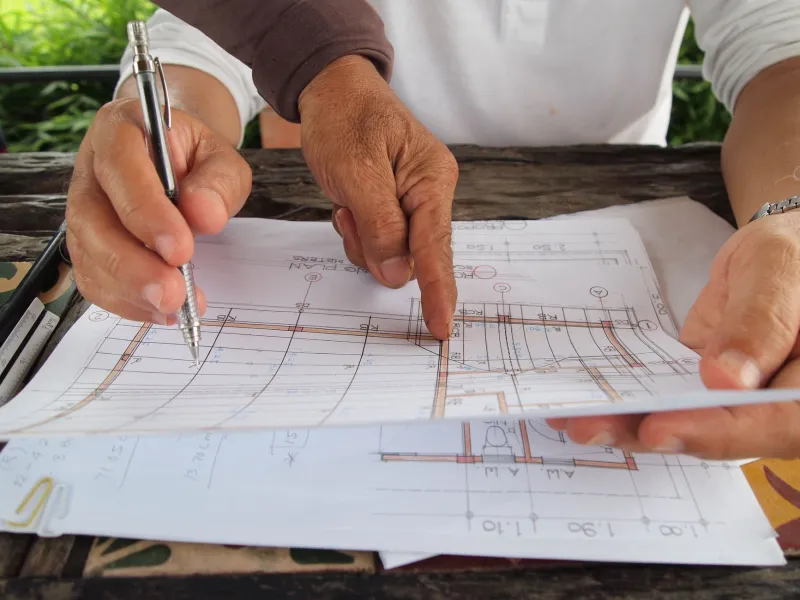
Documentation is often the largest line in a design fee, and it is the one most likely to be undervalued by clients. It includes drawings, specifications, details, coordination with consultants such as mechanical, electrical, and structural engineers, and preparation of permit submissions. It is not paperwork appended to the real work; it is where ambiguity is resolved and where contractors derive competitive bids.
Thin documentation has a predictable consequence. Contractors price what they cannot see as an allowance, and allowances become change orders. A complete drawing set may appear to cost more at the proposal stage, but it frequently costs less by the end of construction. Ask whether permit response and consultant coordination are included, and ask how many sheets the firm expects the set to contain.
Procurement and Installation Oversight
Furniture, fixtures, and equipment procurement is a separate discipline from design, and not every firm includes it. When it is included, the fee covers schedules, bid leveling, purchase orders, delivery coordination, and punch-list management. When it is excluded, the owner inherits a series of vendor relationships, shipping deadlines, and damage claims.
This line item is best understood as risk transfer. The firm is not merely ordering chairs; it is managing the sequence in which materials arrive and the process by which defects are corrected. Ask whether receiving, installation, and replacement of damaged goods are covered, and who is responsible when a vendor misses a delivery window.
Post-Installation Support
Post-installation support is usually a small line, and it is easy to overlook. It may include a warranty walk, adjustment of lighting or casework, training for staff, and delivery of as-built documentation. A firm that disappears after the final invoice leaves the owner to manage these items alone.
The value here is disproportionate to the cost. A two-hour adjustment visit can resolve issues that would otherwise linger for months. Ask how long the support period lasts and what response time the firm commits to.
Reading Two Proposals Side by Side
The most reliable way to compare proposals is to build a matrix of services rather than a column of totals. List deliverables, meetings, revision rounds, consultant coordination, permit responses, procurement responsibilities, and post-occupancy support. Note every allowance and every exclusion. A low fee paired with extensive owner responsibilities is not comparable to a higher fee that absorbs those responsibilities.
Pay particular attention to language such as “design services as required” or “coordination with owner’s vendors.” These phrases are not inherently problematic, but they shift work and risk. The question is whether the shift is intentional and priced.
What to Pay For—and What to Question
It is generally worth paying for documentation depth, procurement oversight, and post-install support. These are the line items that protect schedule, budget, and the quality of the finished space. It is reasonable to question a lump sum with no hours attached, a discovery phase that seems too brief for the building, or an “unlimited revisions” clause that lacks a definition of completion.
A well-built fee is not the lowest one. It is the one that makes the work visible before the work begins. When the scope is clear, the total becomes a summary of a shared understanding rather than a hopeful estimate.