Version Five: An Honest Account of How We Rebuilt Our Own Client Process
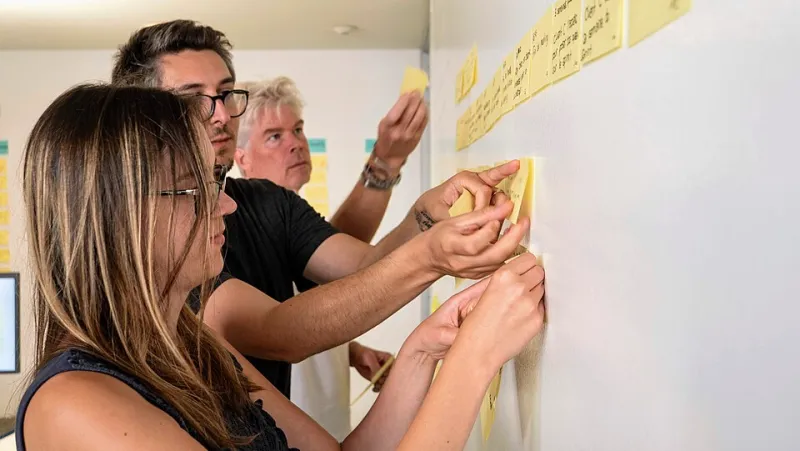
Photo: Design Sprint Ltd, CC BY-SA 4.0, via Wikimedia Commons
Design firms are quick to preach process to clients and slow to examine their own. Over the past three years, we rebuilt ours five times — not as a branding exercise, but because each version broke in ways that cost our clients time, money, or patience. What follows is the post-mortem we would want to read before hiring any firm, including ours.
Version One: The Intake Questionnaire Nobody Read
Our first process was conventional: a lengthy intake questionnaire, a kickoff meeting, and a creative presentation two months later. It broke immediately. Clients filled out the questionnaire in ten minutes, the kickoff surfaced conflicting answers, and the big reveal — the industry's favorite ritual — produced feedback that arrived all at once, too late, and often in contradiction.
The lesson: a document is not discovery. We needed conversations, not forms.
Version Two: More Meetings, More Problems
So we overcorrected. Version two added weekly check-ins, shared boards, and a rolling feedback stream. Clients were engaged like never before — and the projects drowned. Feedback arrived from five people with five priorities, scope crept one small request at a time, and our team spent more time managing opinions than designing.
The lesson: access without structure is not collaboration. It is a leak.
Version Three: The Gate System
Version three introduced decision gates. Discovery closed with a signed brief. Concept closed with a single decision-maker signing off. Revisions were batched, not continuous. This fixed scope creep almost entirely — but it swung too rigid. Clients felt processed rather than heard, and legitimate mid-stream insights got parked behind gate schedules because the process demanded it.
The lesson: structure protects the project, but rigidity protects no one.
Version Four: Tools Outpaced Trust
We then invested heavily in tooling — project dashboards, automated approvals, structured feedback forms. The dashboards were impressive. They were also ignored. Clients defaulted to email threads, approvals happened verbally in hallways, and we discovered that no platform fixes a relationship problem: when a client does not know who owns a decision, no software will tell them.
The lesson: tooling documents decisions; it cannot create them.
Version Five: What We Run Today
The current process is simpler than anything that preceded it, and it is the one every LC2 client experiences now.
- A named decision-maker from day one. Not a committee. One person who signs off, with a defined channel for gathering internal input beforehand.
- Discovery as dialogue. A structured brief built through two working sessions rather than a questionnaire — written by us, confirmed by the client.
- Three checkpoints, not a stream. Brief, direction, and refinement. Each has a defined output, a clear decision, and a documented scope boundary.
- Batched revisions with a published limit. Clients know exactly how many revision rounds are included and what happens beyond them. No ambiguity, no surprise invoices.
- A single source of truth. All decisions recorded in one place the client can access, with email reserved for logistics only.
Why We Are Telling You This
Because the version history of our process is, in a real sense, the product. Every failure documented above was paid for — in hours, in goodwill, in projects that ran longer than they should have. Version five exists so our clients never pay that tuition themselves.
When you evaluate a design firm, ask how they handle feedback, who signs off, and what happens when scope shifts. If they cannot answer in specifics, they have not done the work we just described. We have — five times.